Rebecca Horne
Rebecca Horne is a German visual artist (born 24th March 1944, Michelstadt, Hesse) (currently lives and works in Paris and Berlin)
Horne is from a generation of German artists who came to international prominence in the 1980’s. She practices Body art, performance art, installation art, sculpture and film. She also writes poetry which is influenced by her work. And sometimes creates work which is influenced by the poetry.
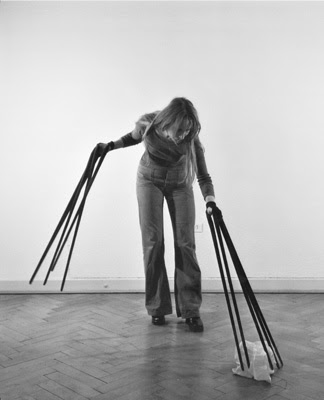
As well as this Horne creates bodily extensions or modifications. with padded body extensions and prosthetic bandages. In the late sixties she began creating performance art and continued to use bodily extensions

Horne spent most of her late childhood in boarding schools and at nineteen rebelled against her parents’ plan of studying economics and decided to instead study art. In 1963 she attended the Hochschule fur bildende Kunste Hamburg (Hamburg Academy of Fine Arts). A year later she had to pull out of art school due to working with glass fibre without a mask. She contracted lung poisoning and remained for a year in a sanatorium after her parents had died also.
This experience gave her a heightened sensory awareness which was projected into her early performances such as ‘Due to her illness having such a hold over her she could only work with softer materials such as coloured pencils which are still her favourite drawing tool.
As she slowly broke out of her isolation she started to create sculpture and strange extensions with balsa wood and cloth whilst lying in in bed. Her goal being to rid herself of her loneliness by communicating through bodily forms.
Many of her works explain the double meaning in the idea of lenses One would think that a large tinted lens exists for protection and cover, but it also has the effect of drawing attention to the person or figure behind it. The paradox of looking out and looking back is explored in her installation piece for Taipei 101, Dialogue between Yin and Yang (2002). The work sets up interactions between viewers, environment and sculpture as it uses binoculars and mirrors to suggest the passive and active energies.


 Heather's blog